CUA-Lite2026-09-06 06:19:47UC Berkeley Launches CUA-Lite: Open-Source Platform for Unified Computer Use Agent Training and EvaluationUC Berkeley researchers have released CUA-Lite, an open-source platform for computer use agents (CUA) that integrates agents, environments, trajectories, evaluation, and training frameworks under a unified workspace, data schema, and command interface. The platform covers desktop, browser, and mobile environments. Its lightweight sandbox runs on any Docker host without requiring /dev/kvm support. The core component, Lite.OSWorld, replicates the OSWorld task suite and evaluator in standard Docker containers, reducing memory usage from 4.1GB to 0.9GB and increasing parallel instances by approximately 4.6 times while maintaining evaluation scores consistent with the original virtual machine version. The platform also includes LiteSample, a unified data schema, and has preprocessed over a dozen existing CUA datasets, published on Hugging Face. It integrates more than 10 agents based on models such as GPT, Claude, and Gemini, along with over 15 benchmarks spanning desktop, browser, and mobile. The framework supports supervised fine-tuning and reinforcement learning via a single command. For example, fine-tuning the Qwen3-VL-2B-Instruct model on Lite.ScaleCUA improved the average episode return from 0.138 to 0.237 on a 332-task evaluation set, an increase of about 71%.370
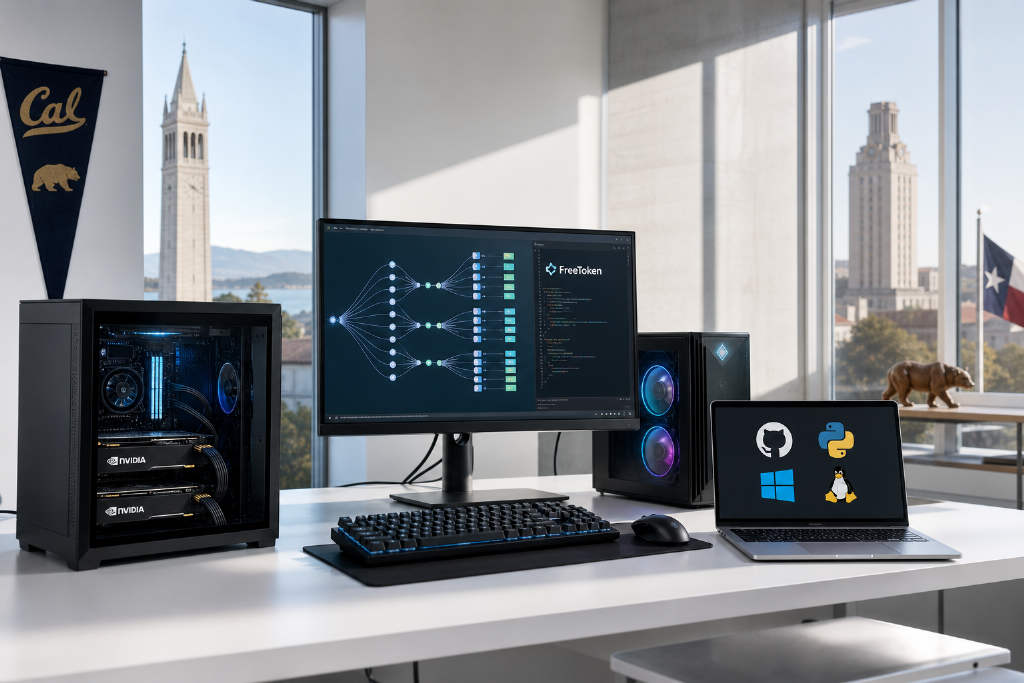
UC Berkeley2026-08-23 10:55:51UC Berkeley and UT Austin researchers release edge-native MoE inference engine FreeTokenResearchers from the University of California, Berkeley and the University of Texas at Austin have introduced FreeToken, an edge-native mixture-of-experts inference engine designed to turn personal computers into a unified elastic inference platform. According to the release cited by Techub, the system can run the 753B-parameter GLM-5.2 model on a single workstation GPU, a 284B model on a gaming desktop, and a 35B model at interactive speed on a laptop GPU with 8GB of VRAM. FreeToken has been open-sourced under the Apache-2.0 license on GitHub and published on PyPI. The team also provides one-click desktop applications for Windows and Linux. Its command-line interface supports Linux x86_64 systems and NVIDIA GPUs, and the ft serve command can expose an API endpoint on port 1919 that is compatible with OpenAI and Anthropic. The project is aimed at individual developers, startups, and engineering teams at small and medium-sized businesses, with a focus on privacy-sensitive use cases such as healthcare, legal work, defense, finance, and intellectual-property-heavy R&D. Example applications include local coding agents, private code review, offline contract analysis, and synthetic data generation.1400
Ripple2026-07-22 08:00:14Ripple UDAX Program Concludes First Pilot at UC Berkeley: Nine Startups Turn Academic Ideas into XRPL ProductsRipple's UDAX pilot at UC Berkeley graduated nine startups in six weeks, achieving product maturity gains of 67% and investor confidence gains of 92%. XRP traded flat near $2.06, with no immediate price impact from the news.480
XRP2026-07-08 20:40:13XRP Holds Key Support at $2.03 as Ripple Expands Real-World Utility with UC Berkeley AcceleratorXRP stabilizes near $2.07 after defending $2.03 support, with selling pressure easing. Technicals show neutral RSI and fading bearish MACD momentum. Ripple's UDAX accelerator with UC Berkeley adds long-term fundamentals. Market awaits breakout direction.410
XRP2026-07-08 20:40:13XRP Holds $2.03 Support, Ripple and UC Berkeley Launch UDAX Accelerator to Boost Real-World Use CasesXRP stabilizes around $2.07 after defending $2.03 support, with selling pressure easing. Ripple partners with UC Berkeley to launch UDAX accelerator, fostering real-world applications on the XRP Ledger. Technical indicators suggest consolidation with neutral momentum.480
Arena2026-07-06 03:29:56Arena Hits $100 Million Annualized Revenue as AI Evaluation Platform Reaches $1.7 Billion ValuationArena, the commercialized successor to UC Berkeley’s open-source Chatbot Arena project, has emerged as one of the most influential third-party benchmarking platforms in the AI industry. The company said its AI Evaluations product reached $100 million in annualized revenue just eight months after launch, underscoring growing demand for real-world model testing beyond traditional benchmark scores. Arena is best known for its blind-comparison leaderboard, where users compare anonymous model responses and generate Elo-style rankings from real interaction data. According to the report, the platform has recorded more than 10 million user evaluations, 700 million conversations, 82 million votes, over 10 million monthly visitors, and participation from more than 150 countries. Major model providers including OpenAI, Google, Anthropic, and Meta have all used the platform to test flagship models. The company’s commercial offering allows AI labs and enterprises to pay for deeper evaluations, using Arena’s large user base to identify strengths, weaknesses, and hallucination issues in deployment-like conditions. After spinning out from Berkeley in 2025, Arena reportedly raised $100 million in seed funding at a $600 million valuation, followed by a $150 million Series A led by Felicis and UC Investments at a $1.7 billion post-money valuation. The platform is also expanding into agent evaluation through a new Agent Mode focused on coding, debugging, research, and long-horizon task completion.1460